Cozy Cravings Recipes
Easy Charcuterie Board for a Cozy Wine Night – 50-Minute
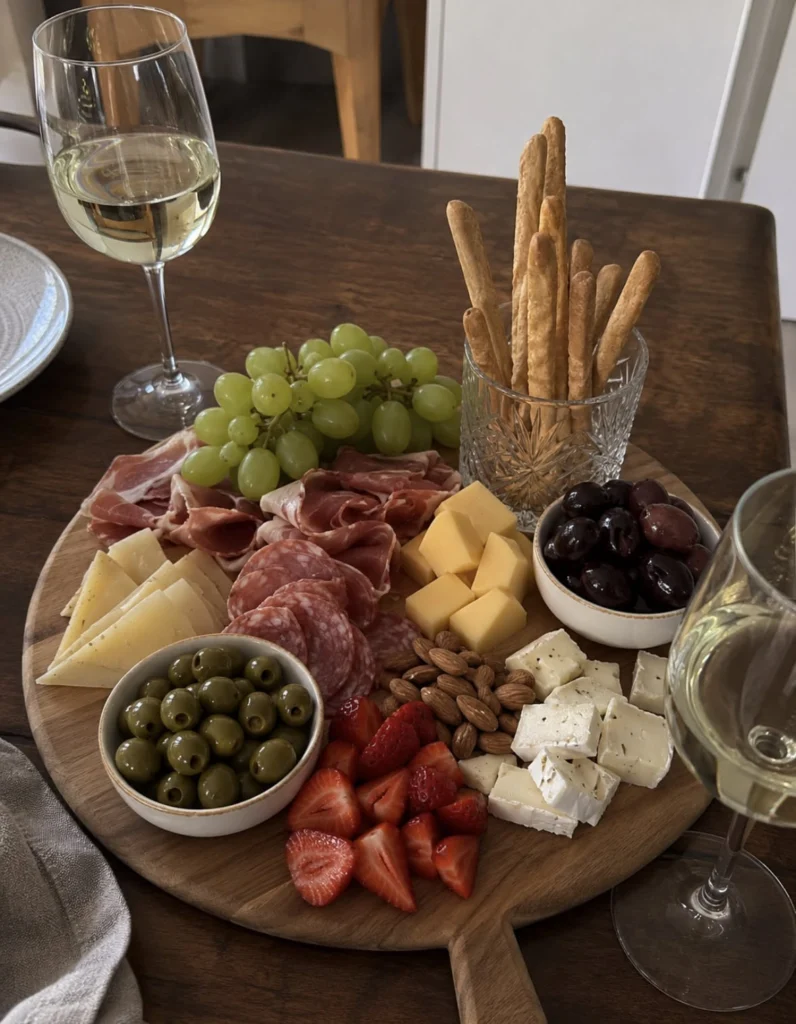
A charcuterie board is the most forgiving appetizer in the world, and this one is built specifically for a slow evening with a glass of red. You are not cooking a meal here - you are arranging a handful of salty, creamy, crunchy, and sweet things so they play off each other, then toasting a few pieces to wake them up. The only real heat involved is a quick stint in the oven for candied nuts and warm baguette slices, and both come together while you open the wine.
The trick to a board that looks abundant without a trip to a specialty shop is balance: two cured meats, two cheeses at different textures, something briny, something fresh, something sweet, and something crunchy. Everything on this list is available at a normal grocery store, and the quantities below fill a large board generously for six people with leftovers.
Prep is 15 minutes of slicing and arranging, plus 35 minutes total oven time split between the nuts and the bread - most of which is hands-off. Build it on a rimmed baking sheet or a big wooden cutting board, and let it sit at room temperature for 20 minutes before guests arrive so the cheese tastes like cheese and not like the refrigerator.
Why You'll Love This Recipe
About the Ingredients
6 oz (170g) thinly sliced prosciutto di Parma
Ask the deli counter to slice it paper-thin so it drapes rather than clumps. If prosciutto is pricey, speck or thinly sliced Black Forest ham works beautifully and costs less.
5 oz (140g) dry-cured salami, sliced 1/8 inch thick
A firm salami like Genoa or soppressata gives the board structure and holds up for hours. Buy a whole small log and slice it yourself for better texture than pre-sliced.
8 oz (225g) double-cream brie wheel
Take it out of the fridge 30 minutes before serving so it spreads. Camembert is the classic substitute, or use a small wheel of triple-cream blue if your crowd likes funk.
4 oz (115g) aged white cheddar, cut into 1/2-inch cubes
A firm, sharp cheese contrasts the brie and can be cubed hours ahead without drying out. Gruyère or aged Gouda are excellent swaps with the same nutty profile.
1 cup (150g) mixed marinated olives, drained
Castelvetrano for buttery and Kalamata for punch is the ideal pair. Buy them from the olive bar rather than a jar so you can mix exactly what you like.
1/2 cup (75g) raw almonds and 1/2 cup (60g) raw walnut halves
Raw nuts toast far better than pre-roasted. Pecans or hazelnuts substitute directly - hazelnuts just need a rub in a towel after toasting to shed their skins.
2 tbsp (42g) honey, plus 1 tbsp (21g) fig jam
Honey thins beautifully with a teaspoon of hot water for drizzling. Fig jam can be swapped for quince paste or apricot preserves with no other changes.
1 cup (140g) seedless red grapes and 1 crisp pear, sliced
Grapes should be firm and cold when you arrange them for contrast. In winter, swap the pear for sliced persimmon or apple tossed in a little lemon juice.
1 small baguette, sliced 1/2 inch thick on the bias (about 16 slices)
Day-old baguette actually toasts better than fresh. A rustic sourdough loaf or good seeded crackers are fine substitutes if you want zero oven work.
3 tbsp (42g) unsalted butter, softened, mixed with 1 minced garlic clove
Garlic butter makes the toasted baguette worth eating on its own. Olive oil brushed on instead keeps it dairy-free and still crisps nicely.
2 sprigs fresh rosemary and 1 tbsp (15ml) olive oil for the nuts
Rosemary goes in whole and gets picked out after toasting so it perfumes rather than overwhelms. Dried thyme works if you have no fresh herbs.
Tips & Tricks
Don't serve cheese cold
Brie straight from the fridge tastes like buttered cardboard. Set it out 30 minutes ahead, and only slice the wedge you plan to eat so it doesn't dry out.
Build in odd numbers and clusters
Groups of three grapes, three salami roses, three cheese cubes read as intentional. Scattering single items evenly looks sparse and messy.
- Toast nuts at 350F (175C) for 8 to 10 minutes and watch them: Almonds go from pale to bitter in under 90 seconds, so pull them when they smell nutty and are one shade darker.
- Slice the baguette on a sharp bias and toast at 375F (190C) for 8 to 10 minutes until the edges are golden brown - thin straight slices burn before the center crisps.
Pro Tips
Step-by-Step Instructions
1. Heat the oven and toast the nuts
Heat the oven to 350F (175C). Toss the almonds and walnuts with 1 tbsp olive oil, the rosemary sprigs, and a pinch of flaky salt on a rimmed sheet pan, then roast for 8 to 10 minutes until one shade darker and fragrant. They are done when a walnut half snaps cleanly and smells nutty - pull them before they look dark, since they keep cooking on the hot pan.
2. Candy the nuts in honey
While still hot, drizzle 1 tbsp of the honey over the nuts and toss with a spatula. Return to the oven for 3 to 4 minutes at 350F (175C) until the honey bubbles at the edges and coats the nuts in a glossy film. Cool completely on the pan for 10 minutes, then pick out the rosemary stems and break the cluster apart.
3. Toast the garlic bread
Lower the oven to 375F (190C). Spread each baguette slice with about 1/2 teaspoon of the garlic butter and arrange on a sheet pan. Bake 8 to 10 minutes until the edges are golden brown and the centers feel crisp when tapped - check at 7 minutes, as thin slices catch fast.
4. Warm the brie if you like
For a soft, spreadable center, set the brie in a small oven-safe dish and bake at 375F (190C) for 8 minutes, until the top gives slightly when pressed and the very edge looks glossy. If you prefer a firm wedge for slicing, skip this entirely - both work.
5. Anchor the big items
Set the brie and the cheddar cubes on a large board or rimmed baking sheet, spacing them apart to create zones. Place the honey and fig jam in small ramekins near the cheeses so they read as part of the cheese station.
6. Build the meat ribbons
Fold each prosciutto slice into a loose ribbon and pile them in the empty space, then shingle the salami slices in an overlapping fan beside it. Keep the meats separated from the wet fruit so they stay crisp.
7. Fill the gaps
Fan the toasted baguette slices in one corner, mound the olives in a small bowl, and cluster the grapes in groups of three around the board. Tuck the pear slices and candied nuts into the remaining holes until no bare board shows.
8. Finish and rest
Drizzle a little honey over the brie and pear, scatter a few rosemary leaves, and grind black pepper over the cheddar. Let the board sit at room temperature for 20 minutes before serving so the cheeses soften and the flavors open up.
Delicious Variations
Mediterranean Board
Swap the cheddar for feta, add hummus and roasted red peppers, and replace the grapes with cherry tomatoes and cucumber spears.
Holiday Board
Use cranberry-fig jam, add pomegranate arils and a wedge of cranberry-studded goat cheese, and toast the baguette with rosemary butter.
Date-Night Board for Two
Halve every quantity, use a small round board, and add two dark chocolate squares and a handful of Marcona almonds for a dessert-leaning finish.
How to Store Easy Charcuterie Board for a Cozy Wine Night
Refrigerator
Store cheeses wrapped separately in parchment then plastic for up to 5 days; keep cured meats in a sealed container up to 4 days. Never refrigerate the toasted bread or candied nuts - they go soft.
Freezer
Candied nuts freeze well in an airtight bag for up to 2 months; thaw at room temperature for 20 minutes. Do not freeze the assembled board, the brie, or the fruit.
Reheating
Re-crisp the baguette at 350F (175C) for 4 to 5 minutes and refresh the nuts at the same temperature for 3 minutes. Serve cheeses at room temperature rather than reheating them.
Frequently Asked Questions
Q: How much charcuterie board food do I need per person?
Plan on 3 to 4 ounces of cured meat and 3 to 4 ounces of cheese per person for an appetizer spread, plus about 4 baguette slices each. For a wine night where the board is the main food, push that to 5 ounces of each and add a second bread option.
Q: Can I make a charcuterie board ahead of time?
Yes, you can assemble the cured meats, firm cheeses, olives, and nuts up to 4 hours ahead and refrigerate the board loosely covered with plastic. Add the soft cheese, toasted bread, sliced pear, and honey drizzle in the last 30 minutes so nothing dries out or goes soggy.
Q: What wine pairs with a charcuterie board?
A medium-bodied red like Pinot Noir or a dry sparkling wine handles the widest range of salty and creamy items on a charcuterie board. If you are serving a big bold Cabernet, lean the board toward aged cheddar and salami rather than delicate prosciutto.
Q: How do I keep the bread from getting soggy on a charcuterie board?
Keep toasted baguette slices away from the fruit, honey, and brie, and place them in their own corner of the board. Brushing the slices with garlic butter before toasting creates a fat barrier that keeps the crumb crisp for a couple of hours.
Q: Can I make this charcuterie board without a wooden board?
Yes, a rimmed baking sheet lined with parchment works perfectly and is actually easier to move and refrigerate. A large platter or even a clean cutting board with a tea towel underneath does the same job.
Grab a bottle of something you love, toast the nuts, and let the board do the rest - tag me in your photos so I can see how you arranged yours, and save this recipe for your next slow Friday night.
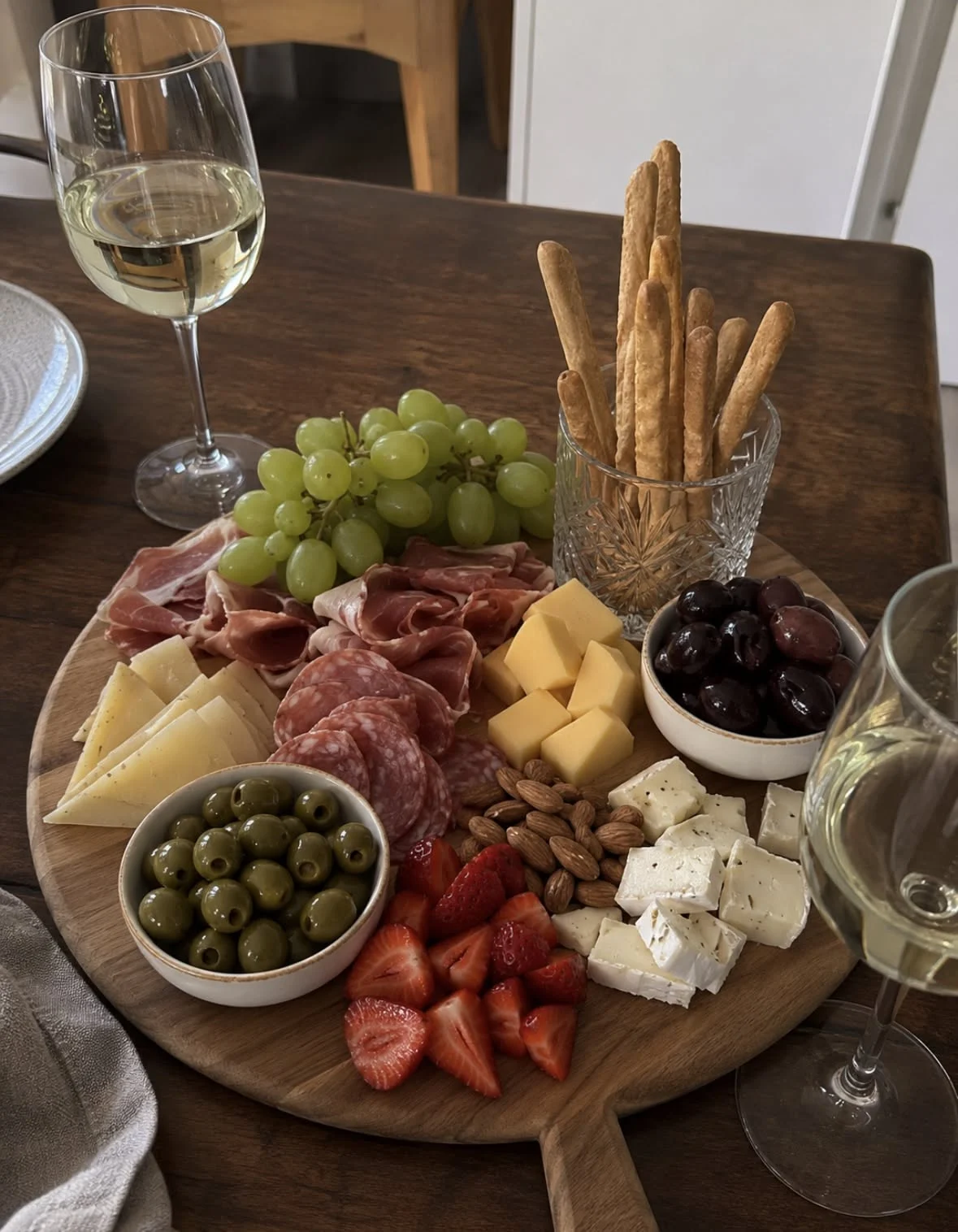
Easy Charcuterie Board for a Cozy Wine Night
This easy charcuterie board for a cozy wine night layers cured meats, soft cheese, honey and toasted nuts into a stunning no-fuss spread in 50 minutes.
🧂 Ingredients
- 6 oz (170g) thinly sliced prosciutto di Parma
- 5 oz (140g) dry-cured salami, sliced 1/8 inch thick
- 8 oz (225g) double-cream brie wheel
- 4 oz (115g) aged white cheddar, cut into 1/2-inch cubes
- 1 cup (150g) mixed marinated olives, drained
- 1/2 cup (75g) raw almonds and 1/2 cup (60g) raw walnut halves
- 2 tbsp (42g) honey, plus 1 tbsp (21g) fig jam
- 1 cup (140g) seedless red grapes and 1 crisp pear, sliced
- 1 small baguette, sliced 1/2 inch thick on the bias (about 16 slices)
- 3 tbsp (42g) unsalted butter, softened, mixed with 1 minced garlic clove
- 2 sprigs fresh rosemary and 1 tbsp (15ml) olive oil for the nuts
📋 Instructions
- 1Heat the oven and toast the nuts — Heat the oven to 350F (175C). Toss the almonds and walnuts with 1 tbsp olive oil, the rosemary sprigs, and a pinch of flaky salt on a rimmed sheet pan, then roast for 8 to 10 minutes until one shade darker and fragrant. They are done when a walnut half snaps cleanly and smells nutty - pull them before they look dark, since they keep cooking on the hot pan.
- 2Candy the nuts in honey — While still hot, drizzle 1 tbsp of the honey over the nuts and toss with a spatula. Return to the oven for 3 to 4 minutes at 350F (175C) until the honey bubbles at the edges and coats the nuts in a glossy film. Cool completely on the pan for 10 minutes, then pick out the rosemary stems and break the cluster apart.
- 3Toast the garlic bread — Lower the oven to 375F (190C). Spread each baguette slice with about 1/2 teaspoon of the garlic butter and arrange on a sheet pan. Bake 8 to 10 minutes until the edges are golden brown and the centers feel crisp when tapped - check at 7 minutes, as thin slices catch fast.
- 4Warm the brie if you like — For a soft, spreadable center, set the brie in a small oven-safe dish and bake at 375F (190C) for 8 minutes, until the top gives slightly when pressed and the very edge looks glossy. If you prefer a firm wedge for slicing, skip this entirely - both work.
- 5Anchor the big items — Set the brie and the cheddar cubes on a large board or rimmed baking sheet, spacing them apart to create zones. Place the honey and fig jam in small ramekins near the cheeses so they read as part of the cheese station.
- 6Build the meat ribbons — Fold each prosciutto slice into a loose ribbon and pile them in the empty space, then shingle the salami slices in an overlapping fan beside it. Keep the meats separated from the wet fruit so they stay crisp.
- 7Fill the gaps — Fan the toasted baguette slices in one corner, mound the olives in a small bowl, and cluster the grapes in groups of three around the board. Tuck the pear slices and candied nuts into the remaining holes until no bare board shows.
- 8Finish and rest — Drizzle a little honey over the brie and pear, scatter a few rosemary leaves, and grind black pepper over the cheddar. Let the board sit at room temperature for 20 minutes before serving so the cheeses soften and the flavors open up.